- In the Geekbench test, the A18 Pro offers 10% better performance than the Snapdragon 8 Elite in single-core tasks.
- However, in multi-threaded tasks, the Snapdragon 8 Elite beats the A18 Pro by 13%.
- In 3DMark, the Snapdragon 8 Elite delivers stellar graphics performance with a stability of 83%.
This year, the competition between Android phones and iPhones is different. Qualcomm has launched its powerful Snapdragon 8 Elite chipset with custom Oryon cores to take on Apple’s A18 Pro chipset. Both are flagship SoCs so we have run several benchmarks including Geekbench, 3DMark, and AnTuTu to compare them comprehensively. On that note, let’s check out the benchmark scores.
Snapdragon 8 Elite vs A18 Pro: Specs Comparison
Snapdragon 8 Elite vs A18 Pro: Geekbench 6 CPU
To test the CPU, we ran Geekbench 6 on Snapdragon 8 Elite and A18 Pro. In single-core tasks, the Snapdragon 8 Elite’s Oryon CPU scored 3,033 whereas the A18 Pro did 10% better, achieving 3,358 points. In multi-core tasks, the eight-core Snapdragon 8 Elite performed better, scoring 9,271 points and the six-core A18 Pro got 8,184 points. In multi-threaded tasks, the Snapdragon 8 Elite leads by 13%, largely due to the two extra cores.
Note that Snapdragon 8 Elite is based on the older Armv8 architecture and has no SME units whereas the A18 Pro is developed on the Armv9 architecture and takes advantage of SME. As a result, it scores slightly better on Geekbench 6.3.
That said, A18 Pro consumes power up to 6.5W whereas Snapdragon 8 Elite pushes the power envelope up to 7.5W to boost the clock speed further. In our testing, surprisingly, the Snapdragon 8 Elite was cooler than the A18 Pro, thanks to Realme GT7 Pro’s large VC chamber. Snapdragon 8 Elite touched 32.8 degrees C after the test, and A18 Pro rose to 35.1 degrees C.
In my assessment, Apple is still the leader in performance per watt as far as the CPU is concerned. However, Qualcomm has come really close to dethroning Apple in the CPU department with its second-gen Oryon cores.

Snapdragon 8 Elite vs A18 Pro: AnTuTu Benchmark
In the AnTuTu benchmark, the Snapdragon 8 Elite delivered impressive performance. It achieved 2,759,190 points whereas the A18 Pro got 1,816,016 points, leading by over 50%. In this test, the stark difference in performance is visible in the GPU department. Snapdragon 8 Elite’s Adreno 830 GPU scored 1,132,574 points, and A18 Pro’s six-core GPU got 728,942 points, resulting in a wide gap of 55%.
It also becomes clear that the Snapdragon 8 Elite enjoys access to much faster memory than the A18 Pro. Not to mention, the Snapdragon 8 Elite’s temperature remained around 36.7 degrees C, while the A18 Pro peaked at 38.3 degrees C.

Snapdragon 8 Elite vs A18 Pro: 3DMark
In the 3DMark Wild Life Extreme Stress test, the Adreno 830 GPU on the Snapdragon 8 Elite delivers remarkable performance. It gets the best loop score of 6,311 points and the lowest loop score of 5,258 points. Notably, the stability stood around 83.3% which is impressive.
A18 Pro’s six-core GPU, on the other hand, gets the best loop score of 4,574 points and the lowest loop score of 3,096 points, with a poor stability of 67.7%. As you can notice, the Snapdragon 8 Elite’s lowest score is even higher than the A18 Pro’s highest score. It means that the Adreno 830 GPU is far superior in graphics performance. Not only that, the temperature also remains nearly the same on both the devices.

In the 3DMark Solar Bay test that evaluates the ray-tracing capability, Qualcomm again outranks Apple. Snapdragon 8 Elite gets an overall score of 10,614 points with an average of 40.36 FPS. A18 Pro, on the other hand, achieves 7,985 points with an average of 30.4 FPS. Once again, the Snapdragon 8 Elite runs two degrees cooler than the A18 Pro.

Snapdragon 8 Elite vs A18 Pro: Geekbench AI
In our testing, the Snapdragon 8 Elite’s Hexagon NPU got poor scores on the Geekbench AI test due to the lack of the QNN framework. Hence, we have not included the scores in our comparison. However, we ran the test on the deprecated NNAPI framework using the CPU and it also didn’t do well. Nevertheless, you can check out the table below to see how both CPUs handle AI workloads.

The Verdict
To sum up, the second-gen Oryon CPU on Snapdragon 8 Elite is very promising, both in terms of performance and efficiency. It has access to a large pool of cache, and despite being on the older architecture, it comes really close to beating A18 Pro’s CPU.
While the A18 Pro’s CPU core is better on paper, due to the advanced cooling system on Android phones, the Snapdragon 8 Elite can sustain its peak performance for a longer period and stay cooler. It’s basically how well the entire system works together, not just the chipset.
As for the GPU, Qualcomm has knocked it out of the park with the new sliced architecture on the Adreno 830 GPU. Apple seriously needs to beef up its mobile GPU for future A-series chips. All in all, it’s an exciting time for Android users who want a flagship experience, on par with the latest and greatest iPhones.

Passionate about Windows, ChromeOS, Android, security and privacy issues. Have a penchant to solve everyday computing problems.
Add new comment
Name
Email ID
Δ

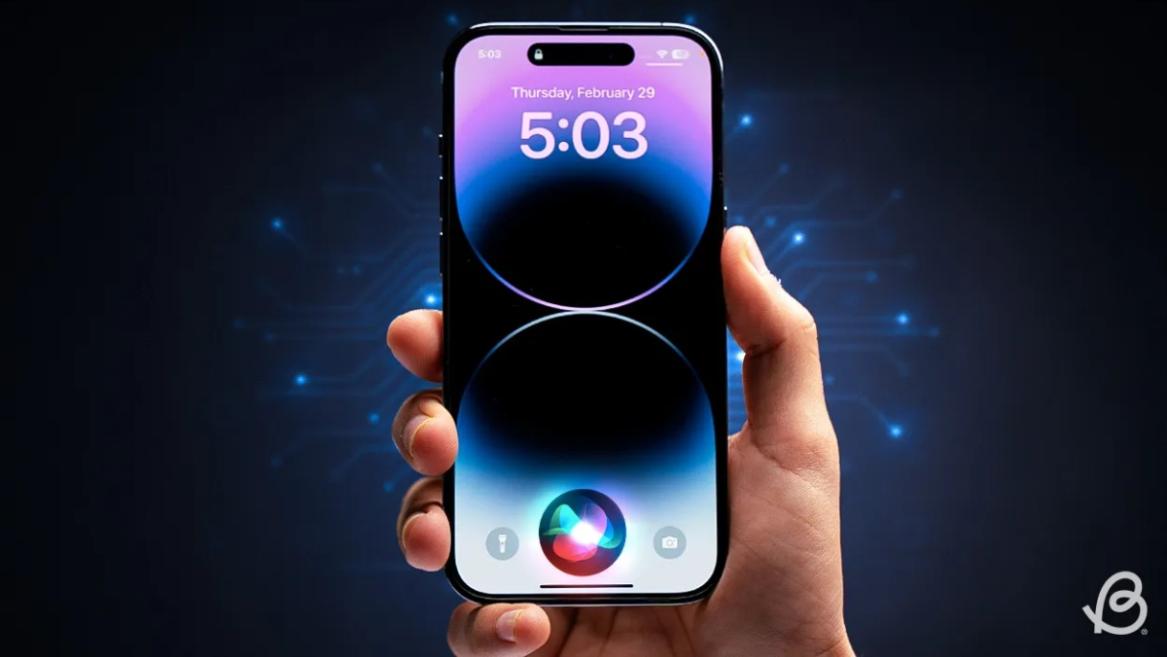
- Apple and Google have officially confirmed their team-up for the next-gen Siri AI.
- The Cupertino Giant will be using Google’s Gemini for a more personalized Siri model as well as Apple Intelligence features.
- We can expect the next-gen Siri to come out with iOS 26.4, sometime in March or April.
Apple has officially confirmed joining forces with Google to use its Gemini AI model to power the next-generation Siri. It will offer a more personalized experience and will be coming out with the iOS 26.4 update. Apple also plans to leverage Gemini’s capabilities for other Apple Intelligence features as well, later down the line.
The Next-Gen Siri will be powered by Google’s Gemini AI
Apple officially confirmed that it will be partnering with Google in a statement to CNBC . Here’s what it stated, “After careful evaluation, we determined that Google’s technology provides the most capable foundation for Apple Foundation Models, and we’re excited about the innovative new experiences it will unlock for our users.”
Later, Google also shared a post on X confirming the tie-up, “Apple and Google have entered into a multi-year collaboration under which the next generation of Apple Foundation Models will be based on Google’s Gemini models and cloud technology. These models will help power future Apple Intelligence features, including a more personalized Siri coming this year.”
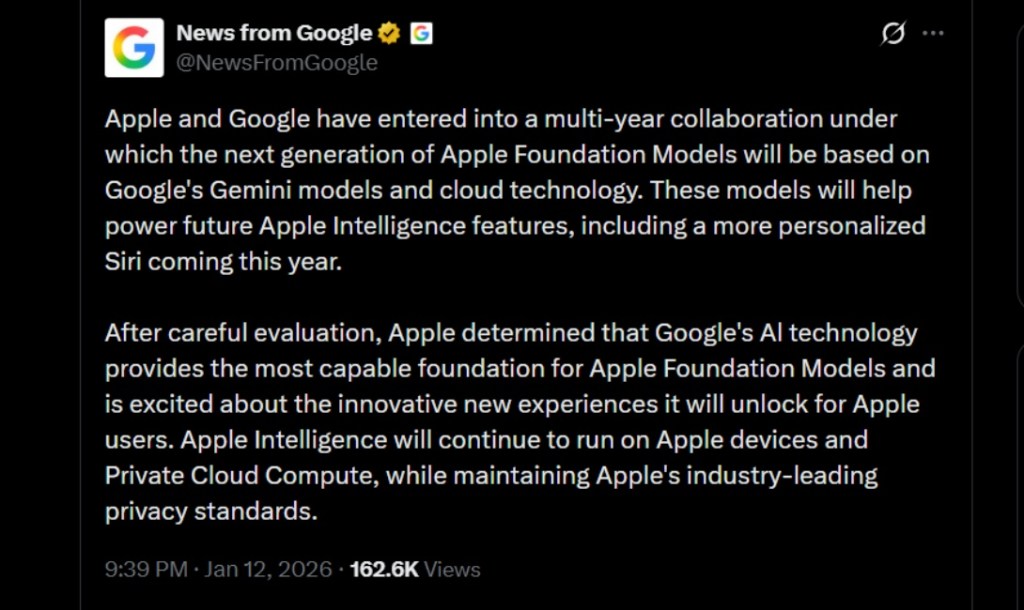
Image Credit: X/@NewsFromGoogle
Both statements clearly mention that the Cupertino Giant will be using Gemini to power its assistant Siri. This was already rumored, as Apple’s attempts to acquire Perplexity went nowhere. With Gemini, Siri will get a major AI update . It will be able to handle more nuanced conversations and provide better results. Something long-time Apple users have been asking for years.
The next-gen Siri will arrive with the iOS 26.4 update, which will launch sometime in March or April. And it is only going to be available for Apple Intelligence-supported devices .
Something else worth noting is how Google’s statement mentions that Gemini will power Apple Intelligence features. This leads us to believe that Apple could use Gemini’s multi-modal capabilities for its Writings tools , Image Playground , and Message summaries, too.
Elon Musk Not Happy With Apple and Google Tie Up
xAI CEO Elon Musk also responded to Google’s announcement post on X, sharing his thoughts on the matter by saying, “This seems like an unreasonable concentration of power for Google, given that they also have Android and Chrome.” Though we don’t expect either Apple or Google to respond to Elon, we will update the situation as it progresses.
It is worth noting that xAI is the company behind Grok, which is in hot water currently due to its inappropriate image generation fiasco , and has been getting backlash from multiple news outlets, X users, and even government authorities.
With over 4 year of experience under the belt, I cover all facets of consumer tech, from smartphones to other consumer electronics, our favorite social media apps, as well as the growing realm of AI and LLMs. As an Apps and AI writer app Beebom, I provide my expertise in all these areas, weaving stories that help you get familiar with the tech around you. But you will find me playing NYT daily puzzles in my free time.
Add new comment
Name
Email ID
Δ
