MacBook Air has become a tried-and-true product for Apple ever since the company ushered in the M-series chips era. M1 MacBook Air brought a revolution and Apple has now repeated the same formula with MacBook Air M4 to bring it another step closer to perfection. I have been rocking a M2 MacBook Air 13-inch for close to 3 years now and when Apple offered Beebom to review the new, kinda Blue (more on this later) and a beefier MacBook Air M4 15-inch, I pounced with both hands. So, here is my MacBook Air M4 review after using it for 2 weeks.
MacBook Air M4 Specs

Image Credits: Beebom
Specs-wise, MacBook Air M4 brings a couple of new additions over its predecessors. We have talked about everything new in the latest addition to the Air family in detail below, but you can check the specs below quickly before you proceed.
Mind it, we have a specced out MacBook Air M4 with a 15-inch display, 16GB RAM, and 1TB storage.
So, What’s New?

Image Credits: Beebom
Now that we have gone over the specifications, it’s time to see what’s new and updated in the MacBook Air M4. Starting with the new color. The MacBook Air M4 comes in a new color option – Sky Blue, which replaces the fan favorite Space Gray color option. Seems like Apple is too fond of silver color that the Sky Blue hue in the new MacBook Air is just a tinge of blue and a whole lot of silver. Despite this, it is refreshing to see Apple break out of the case of monotonous and bland color options.
Next, Apple now offers 16GB RAM in the base variant of the M4 MacBook Air, up from 8GB RAM in the predecessor. It is one of the most welcoming upgrades from Apple, considering the ire the company has faced from reviewers and users alike for offering 8GB RAM in a laptop that costs $1000. With the M4 MacBook Air, you can purchase up to 32GB RAM, compared to the previously capped storage option of 24GB.
While we are on the price, there’s another welcome addition. Apple has lowered the pricing of the MacBook Air lineup, and the M4 MacBook Air M4 base model starts at $999 now (the 15-inch model starts at $1,199). This is $200 less than the launch price of the M2 MacBook Air and $100 less than what the M3 MacBook Air launched for. I know it is absolutely unbelievable that Apple has launched a product at a lower price while offering increased RAM and storage! Fret not, I think Apple has balanced out things by introducing the iPhone 16e at a whopping $599!
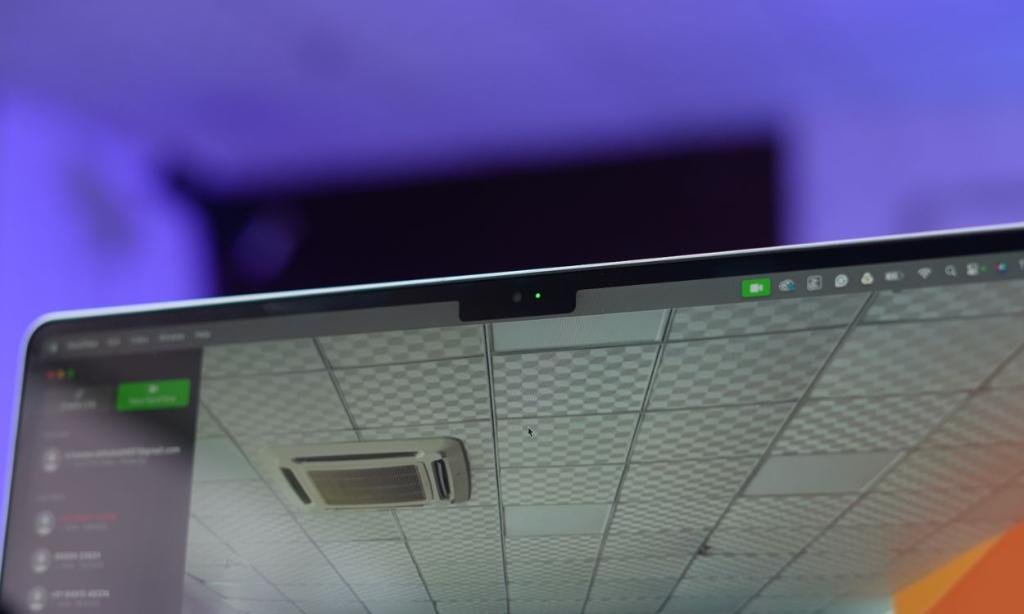
Image Credits: Beebom
The MacBook Air M4 is an incremental upgrade, but Apple has added some new and useful features, like the new webcam, which is 12MP now and supports Center Stage. This is an upgrade from a 1080p webcam (equivalent to 2.1MP) in the previous MacBook Air model. The new webcam also supports the Desk View feature that can show the top-down view of your desk in video calls. Video calls are sharper, clearer, and carry more detail as compared to my M2 MacBook Air with 1080p webcam.
Tried and Tested Design

Image Credits: Beebom
Ever since the design refresh in MacBook Air M2 with a notch and more symmetrical curves on the side, Apple has dared not to experiment with design. MacBook Air M4 is no different. It has the same 15.3-inch LCD Display with 500 nits brightness, the same dimensions, and even the same weight at 1.51 kg as the MacBook Air M3. When I say that Apple has not dared to experiment with the design, it’s mainly because it’s nearly perfect with not much left to desire. You get a sleek design with an easy-to-open lid, a sturdy hinge, and a wobble-free bottom.
Coming from a 13-inch M2 MacBook Air, the new M4 MacBook Air with its 15-inch display was not an easy change. Despite the weight difference of just 0.27 kg, the new MacBook felt a bit hefty and don’t even get me started on getting used to the bigger keyboard. Nonetheless, design-wise, the M4 MacBook Air is simply perfect with a gorgeous display, a MagSafe charging port, and two USB-C ports on the left, and the sole 3.5mm Audio jack on the right.

Image Credits: Beebom
Talking about ports, Apple has updated USB-C ports from Thunderbolt 3 to Thunderbolt 4 now, which does not really translate to any meaningful real-life benefit other than the fact that now you can connect two 6K external displays while keeping the lid of your MacBook open.
If you are disappointed that there’s nothing new, I have something to cheer you up. The MacBook Air M4 comes in a new color option – Sky Blue, which replaces the fan favorite Space Gray color option. Seems like Apple is too fond of silver color that the Sky Blue hue in the new MacBook Air is just a tinge of blue and a whole lot of silver. Despite this, it is refreshing to see Apple break out of the case of monotonous and bland color options.
The Mighty, Powerful M4 Chip

Image Credits: Beebom
Coming to the most interesting aspect of the new MacBook Air – the new M4 chip . The M4 chip is not a new processor per se. We’ve already had the iPad Pro M4, the Mac mini M4, and the MacBook Pro M4 for some time now. Now, the chip has made its debut in the Air lineup. Let’s quickly go over the specification of the M4 chip before I delve deeper into the real-life applications and performance boost I have experienced with the M4 chip.
So, the M4 chip has a 10-core CPU with 4 performance cores and 6 efficiency cores. As compared to the M3 chip, there are two additional CPU cores in the M4 chip. There’s a 10-core GPU in the 15-inch MacBook Air M4. If you opt for the 13-inch base model, you get an 8-core GPU. Additionally, the M4 MacBook Air brings Hardware-accelerated ray tracing, a 16-core Neural Engine, and 120GB/s memory bandwidth.
All MacBook Air models are fanless and rely on passive cooling, unlike MacBook Pro models, and the M4 MacBook Air is no exception. While this makes the operation noiseless, we experienced in our tests that the machine throttles under sustained load. Throttling was visible when I tried to render an 8K video in Final Cut Pro.
This brings us to benchmarks. Below, you can find the results for the benchmark tests I ran on the MacBook Air M4.

Comparing benchmarks with the predecessors, it is clear that the M4 MacBook Air is ~25% faster than the M3 MacBook Air in single-core and multi-core Geekbench scores, whereas it is 10% better in the graphics department. Thus, upgrading from an M3 MBA won’t make sense. If you’re using an M1 MacBook Air, you will get nearly double the performance.
M1 MacBook Air scores 2402 in the single-core Geekbench test and 8608 in the multi-core test. On the other hand, the M4 MacBook Air scores 3770 in single-core and 14687 in the multi-core test. So, yes, the performance boost is significant.
When Apple introduced the M4 MacBook Air M4, it emphasised on M4 chip’s powerful Neural Engine, which “accelerates AI-based tasks,” so I tried to put it to the test by running a local LLM model. For testing, I used LM Studio to run Deepseek-r1-distill-qwen-7b model and it generated 1859 tokens at 17.77 tokens/second and took 0.27 seconds to generate the first token. I tried multiple prompts and the results were almost instant.

This is the 16GB variant that I am testing, and only once did it stutter a bit when I tried running Death Stranding while a 4K video was rendering in the background.
MacBook Air M4 Battery Life

Image Credits: Beebom
One department where MacBook Air M4 really proves its mettle is the battery performance. Apple claims that its latest MacBook Air delivers up to 18 hours of battery life, and in real-life tests, these claims were pretty close. My workflow involves opening multiple tabs on Chrome and Safari, using Notion extensively for workflow management, Slack for communication, Apple Music in the background, doing most of these tasks, and occasional photo editing.
With this typical usage, MacBook Air M4 lasts up to 16 hours easily before I have to feed it the juice again. During my testing of the machine, I put it through an extensive load as well. I rendered a 4K video in Final Cut Pro, ran an LLM model locally, and also did benchmark testing. In my extensive testing, the M4 MBA impressed me with 12 hours of battery life, which is impressive to say the least.
As for charging, it comes with a 35W Dual USB-C adapter and a color-matched braided charging cable in the box. To fuel the MBA M4 to 100%, it takes around 2 hours and 15 minutes using the stock adapter.
But…
So far in my MacBook Air M4 review, I have listed out all the positives of the machine, and honestly, there is not much to complain about. Still, I have a bone to pick with Apple. Firstly, the 60Hz LCD display on a $1,000 laptop is petty in 2025. The Windows counterparts are offering an OLED display with a much higher refresh rate in the same price segment. It’s about time that Apple starts offering mini-OLED in MacBook Air models.
Next, the lack of ports on the MBA makes it a deal breaker for several users. I agree that it is an entry-level laptop offered by Apple, but with a highly capable chipset and minimal ports, it is an overkill. I would love to see an Ethernet and SD card port on MacBook Airs someday.
Should You Buy the MacBook Air M4?
Now comes the most important question: Should you buy the MacBook Air M4? In fact, the right question to ask is who should buy the MacBook Air M4? Well, switching from an M2 or M3 MBA isn’t a sensible decision you’d want to take, as the performance gains are not worth the hassle. However, if you are planning to upgrade from an M1 MacBook Air, there’s a lot to gain.
You’d gain almost a 60-70% increase in performance in GPU, CPU, and graphics, a new design, and a future-proof device. Now, if you are confused between MacBook Air M4 and MacBook Pro M4, note that the price difference is now steep, as the latter costs $1,599 compared to the $999 pricing of the MBA M4. But with this $500, you get a mini-LED display with a 120Hz refresh rate, additional battery life of around 6 hours, 512GB base storage, and additional ports (HDMI and SDXC card slot).
So, the choice eventually comes down to your requirements. If you want a machine for day-to-day tasks, MacBook Air M4 is the one to go for. If you’re a student, you can avail Apple’s Student pricing for MBA M4 and get it at $899, which is definitely a steal deal.

With seven years of experience in digital media, including more than three years as an editor, I have successfully transitioned from tech to the vibrant world of entertainment. I previously served as a Senior Tech Writer at Fossbytes Media, but my passion for movies and television led me to pivot. As an Entertainment Editor at Beebom, I manage and create content covering movies, TV shows, and anime across major streaming platforms like Netflix, HBO Max, and Disney+. I’m an avid fan of timeless classics and modern hits, with a particular love for the horror genre.
Add new comment
Name
Email ID
Δ


- Apple and Google have officially confirmed their team-up for the next-gen Siri AI.
- The Cupertino Giant will be using Google’s Gemini for a more personalized Siri model as well as Apple Intelligence features.
- We can expect the next-gen Siri to come out with iOS 26.4, sometime in March or April.
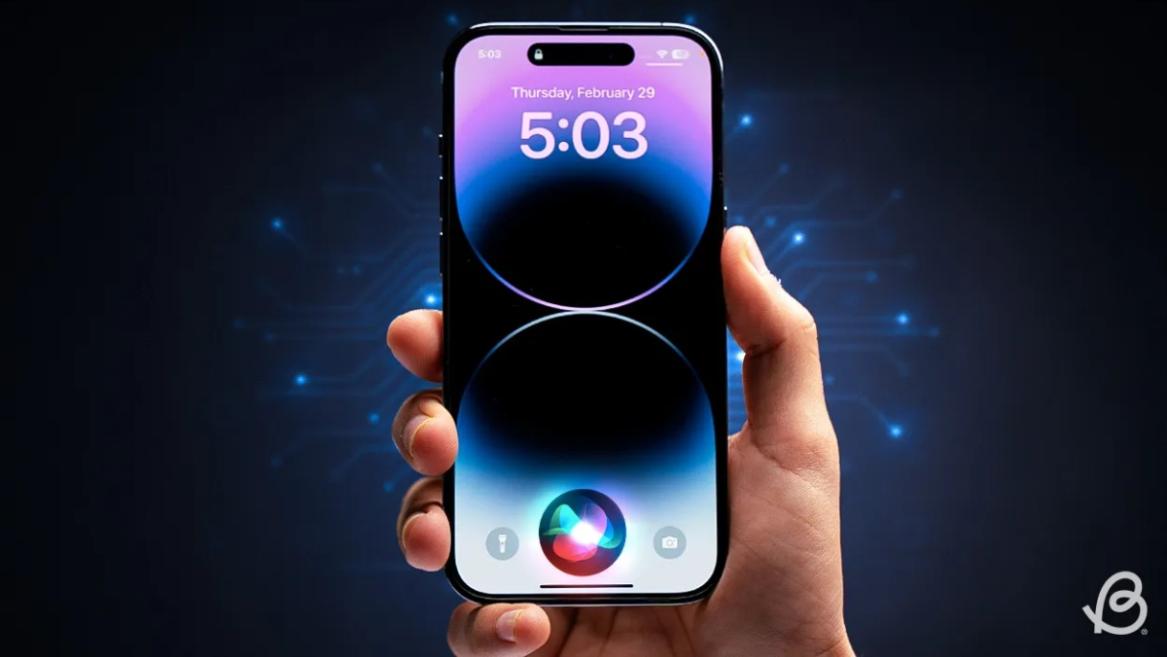
Apple has officially confirmed joining forces with Google to use its Gemini AI model to power the next-generation Siri. It will offer a more personalized experience and will be coming out with the iOS 26.4 update. Apple also plans to leverage Gemini’s capabilities for other Apple Intelligence features as well, later down the line.
The Next-Gen Siri will be powered by Google’s Gemini AI
Apple officially confirmed that it will be partnering with Google in a statement to CNBC . Here’s what it stated, “After careful evaluation, we determined that Google’s technology provides the most capable foundation for Apple Foundation Models, and we’re excited about the innovative new experiences it will unlock for our users.”
Later, Google also shared a post on X confirming the tie-up, “Apple and Google have entered into a multi-year collaboration under which the next generation of Apple Foundation Models will be based on Google’s Gemini models and cloud technology. These models will help power future Apple Intelligence features, including a more personalized Siri coming this year.”
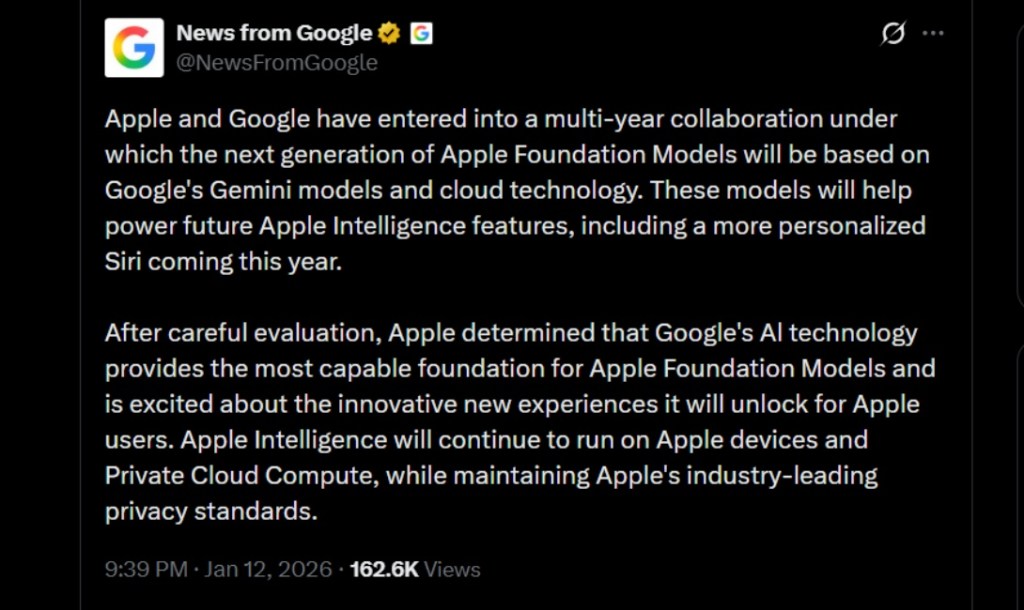
Image Credit: X/@NewsFromGoogle
Both statements clearly mention that the Cupertino Giant will be using Gemini to power its assistant Siri. This was already rumored, as Apple’s attempts to acquire Perplexity went nowhere. With Gemini, Siri will get a major AI update . It will be able to handle more nuanced conversations and provide better results. Something long-time Apple users have been asking for years.
The next-gen Siri will arrive with the iOS 26.4 update, which will launch sometime in March or April. And it is only going to be available for Apple Intelligence-supported devices .
Something else worth noting is how Google’s statement mentions that Gemini will power Apple Intelligence features. This leads us to believe that Apple could use Gemini’s multi-modal capabilities for its Writings tools , Image Playground , and Message summaries, too.
Elon Musk Not Happy With Apple and Google Tie Up
xAI CEO Elon Musk also responded to Google’s announcement post on X, sharing his thoughts on the matter by saying, “This seems like an unreasonable concentration of power for Google, given that they also have Android and Chrome.” Though we don’t expect either Apple or Google to respond to Elon, we will update the situation as it progresses.
It is worth noting that xAI is the company behind Grok, which is in hot water currently due to its inappropriate image generation fiasco , and has been getting backlash from multiple news outlets, X users, and even government authorities.
With over 4 year of experience under the belt, I cover all facets of consumer tech, from smartphones to other consumer electronics, our favorite social media apps, as well as the growing realm of AI and LLMs. As an Apps and AI writer app Beebom, I provide my expertise in all these areas, weaving stories that help you get familiar with the tech around you. But you will find me playing NYT daily puzzles in my free time.
Add new comment
Name
Email ID
Δ
- Apple is close to finalizing a $1 billion deal with Google to use Gemini to power the next-gen Siri.
- It will use a custom version of Gemini AI, which will be used temporarily until Apple develops its own powerful AI model.
- The new AI-powered Siri is slated to launch sometime next spring.
Apple is reportedly set to close an estimated $1 billion annual deal with its rival, Google, to use a custom version of the Gemini AI model to power the next version of Siri. Apple is lagging behind major companies in the AI race so this might help the Cupertino giant to make a comeback.
Apple Turns to Gemini to Power Its AI-Powered Siri
This detail comes from Bloomberg , which reports that Apple is turning to Google’s Gemini as a temporary solution until its own AI model catches up with the rest of the industry. Once ready, it will be used to power a host of new Apple Intelligence features which the company has in the pipeline.
For context, the custom version of Google’s Gemini AI model has about 1.2 trillion parameters , which far exceeds Apple’s current cloud-based AI model which are trained on 150 billion parameters. This shows that Gemini can handle far complex tasks and commands compared to Apple’s in-house model.

Image Credit: Beebom
Typically, the Cupertino Giant prefers to make things on its own, but it has been lagging in the AI race behind several major companies and startups. Apple had plans to acquire Perplexity , and even held talks with OpenAI , but it seems like Gemini is the best fit the company has found for its AI-powered Siri , which is scheduled to come out sometime next spring.
However, there is still some time till then, and Apple’s plan could still change if the deal doesn’t go through.
With over 4 year of experience under the belt, I cover all facets of consumer tech, from smartphones to other consumer electronics, our favorite social media apps, as well as the growing realm of AI and LLMs. As an Apps and AI writer app Beebom, I provide my expertise in all these areas, weaving stories that help you get familiar with the tech around you. But you will find me playing NYT daily puzzles in my free time.
Add new comment
Name
Email ID
Δ
