With the rise of online businesses, cloud computing has received a massive boost and will continue to usher even more with the forthcoming, fast-paced improvements in AI. Virtualization, allocating multiple virtual machines, and populating them with resources is an integral part of cloud computing; and platforms such as VMware are popular for the same. However, if you don’t like it, here are all the VMware alternatives you can use.
Best VMware Alternatives for Virtualization
While some of these VMware alternatives are free for individuals, others are exclusively geared toward small to big scale enterprises. The latter is where you usually find flexibility in terms of scalability and migration. And that’s where you also find more peace of mind.
1. Microsoft Hyper-V

Hyper-V is an excellent VMware alternative if you’re already running a Windows server or the latest Windows version. It supports both Windows and Ubuntu Linux , and managing hosts is quite easy via the Hyper-V manager or from the Windows PowerShell.
One of the standout features of Hyper-V is the live migration feature, which, as the name suggests, doesn’t add downtime when migrating resources. Hyper-V also supports nested virtualization and since it comes bundled with Windows, you would only need to pay for Windows and the hardware, and it’d be free thereafter. Overall, Hyper-V is one of the best VMware alternatives you could use.
2. Red Hat Virtualization
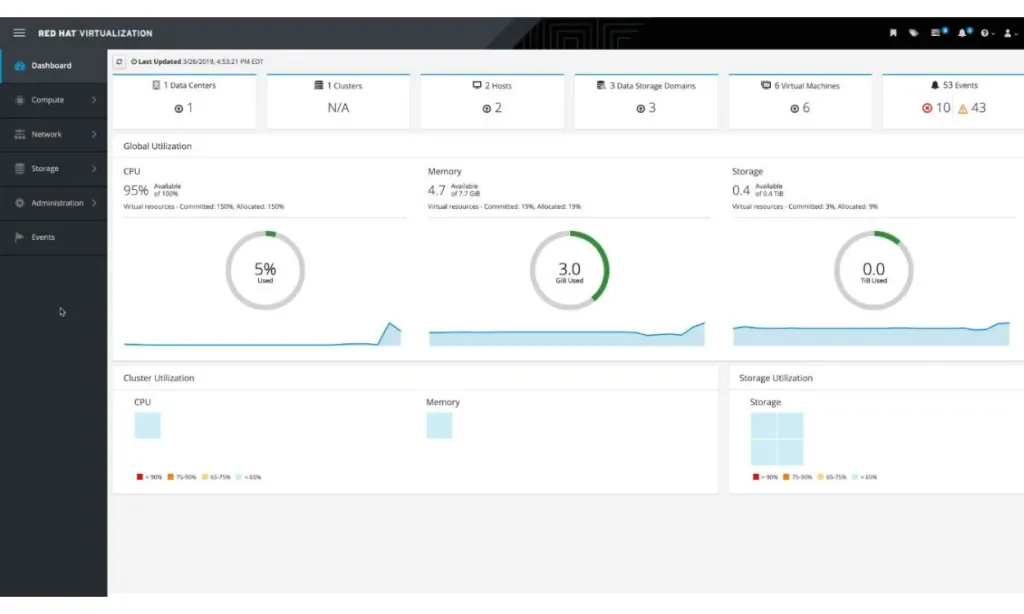
Image: Red Hat
Red Hat is a popular name in the enterprise-grade virtualization and cloud computing community, and that’s because of the firm’s extensive list of products that make it easier for businesses and huge firms to host virtual machines and manipulate and store data.
RHV uses a Kernel-based Virtual Machine aka KVM with Linux, which is not only faster but also very resource efficient. This also makes Red Hat Virtualization scalable for workloads, and more secure, and enterprises also get access to RHEL (Red Hat Enterprise Linux) which is dubbed as one of the best server Linux solutions out there.
3. VirtualBox

Oracle’s VirtualBox is quite popular when it comes to VM solutions for both enterprises and personal computers. Hence, if you’re just starting out and looking to run VMs on a powerful server/PC, it’s a good alternative to VMware.
For starters, it’s open source and supports running and running on almost all popular operating systems, including macOS, Linux, Windows, and the old-school BSD and Solaris. It’s quite scalable, supports snap-shotting to easily save the states of VMs, and also supports external devices. Besides, it performs quite well.
4. Nutanix Cloud

Image: Nutanix
Nutanix is one of the best alternatives to VMware thanks to its hybrid cloud model, which provides an agile cloud infrastructure to host your Virtual Machines and apps. It uses HCI (Hyper-converged Infrastructure) that not only gives you more power but also a better virtualization experience.
Besides, it’s extremely scalable while also being secure . If your business has a great number of users, Nutanix makes more sense as it offers a better user management system while being extremely cost-effective. It’s definitely one of the best alternatives to VMware.
5. Parallels Desktop

We’ve featured Parallels many times on the blog because it makes it easier to run virtual machines on different platforms. Parallels Desktop is more suited for individuals . It’s cross-platform and the VMs created using the same integrate very well with the host. The performance is also on the good side as Parallels Desktop can make use of various technologies like dynamic resource allocation.
Besides, since it’s geared toward individuals, it’s extremely user-friendly. The best use case for Parallels is to effortlessly run various VMs on operating systems, like running Windows on ChromeOS using a VM. All good things come at a price, and Parallels Desktop is no different. If you’re looking for a good VM to run different operating systems on macOS, Windows, or ChromeOS , Parallels Desktop is the answer and a good alternative to VMware.
6. SUSE Linux Enterprise Server

Meant for enterprise users, SLES is a great alternative to VMware. For starters, it’s from what’s arguably one of the best companies pioneering cloud computing and taking the same forward, SUSE. They have all sorts of enterprise management systems, including container management and public cloud spanning across different industries like Retail, Telecom, Pharma, etc.
SLES is open-source and is available across different cloud providers such as AWS, Azure, and Google Cloud. Since it runs both KVM and Xen , it’s much faster, secure, and scalable. Besides, it’s also one of the longest-supported enterprise servers per version and is much easier on the pocket. Overall, it’s easily one of the best alternatives to VMware.
7. Proxmox VE
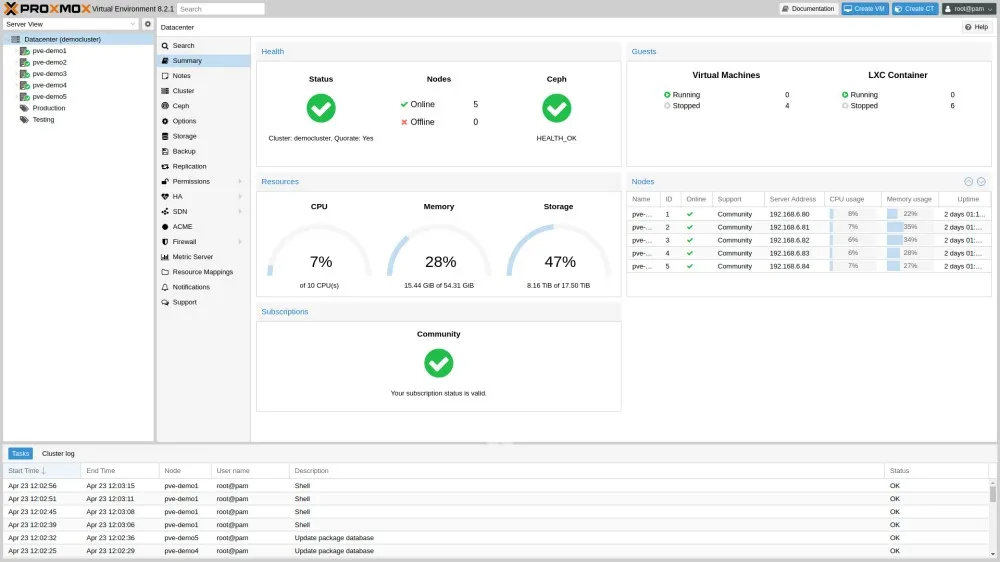
Image Credit: Proxmox
Proxmox offers various enterprise grade solutions and a Virtual Environment is one of them. For starters, it’s an open source containerization and virtualization platform with a web interface to easily manage virtual machines. It leverages KVM and LXC and offers a pretty robust, scalable environment for enterprises as well as advanced users.
There’s live migration, high availability clustering, and built-in backup and restore options, making it a reliable VMware alternative. However, one of the main reasons to choose Proxmox is due to its cost-effectiveness. Proxmox is free for users and costs a bit less than VMware for enterprises. The top-most tier of Proxmox VE costs $1060/year, but you can bag the standard subscription for $530. Overall, Proxmox VE is easily one of the best VMware alternatives.
8. Citrix Hypervisor

Image Credit: Citrix
Previously known as XenServer, Citrix Hypervisor promises to offer excellent performance or enterprises with great scalability and efficiency. Some of the standout features of the same are GPU pass-through and live migration of VMs without systems going down.
While it may not be suitable for small scale organizations who are just starting out, it’s a great VMware alternative for firms that manage large-scale virtual environments for application delivery. As mentioned earlier, performance is its strong suite, which makes it great to run higher workload applications involving virtual desktops. Overall, Citrix Hypervisor is definitely one of the best VMware alternatives you can use.
Factors to Choose the Perfect VMware Alternative
So these were some of the best VMware alternatives you can use. Some of the key pointers to remember in mind when making a decision are as follows:
- KVMs are faster but have a learning curve. However, they could yield better results in a longer run than Hypervisors.
- An open-source VMware alternative ensures patches come in faster and the virtual machines and hosts are always secure.
- Scalability is important. Always choose the one that offers excellent scalability and flexibility to meet and tweak the needs on the go.
Abubakar covers Tech at Beebom, with his passion for technology tracing back to 2011 when he received a Dell Inspiron 5100 as a gift. He’s also a passionate advocate for the right-to-repair movement, believing in empowering users to maintain and extend the life of their devices. Outside the tech world, he enjoys watching anime and exploring his newfound enthusiasm for Japanese cars. In his free time, you’ll often find him immersed in Genshin Impact or researching his next gadget purchase. Before joining Beebom, he contributed to leading publications like Android Police, How-To Geek, and Fossbytes.
Add new comment
Name
Email ID
Δ



- Apple and Google have officially confirmed their team-up for the next-gen Siri AI.
- The Cupertino Giant will be using Google’s Gemini for a more personalized Siri model as well as Apple Intelligence features.
- We can expect the next-gen Siri to come out with iOS 26.4, sometime in March or April.
Apple has officially confirmed joining forces with Google to use its Gemini AI model to power the next-generation Siri. It will offer a more personalized experience and will be coming out with the iOS 26.4 update. Apple also plans to leverage Gemini’s capabilities for other Apple Intelligence features as well, later down the line.
The Next-Gen Siri will be powered by Google’s Gemini AI
Apple officially confirmed that it will be partnering with Google in a statement to CNBC . Here’s what it stated, “After careful evaluation, we determined that Google’s technology provides the most capable foundation for Apple Foundation Models, and we’re excited about the innovative new experiences it will unlock for our users.”
Later, Google also shared a post on X confirming the tie-up, “Apple and Google have entered into a multi-year collaboration under which the next generation of Apple Foundation Models will be based on Google’s Gemini models and cloud technology. These models will help power future Apple Intelligence features, including a more personalized Siri coming this year.”
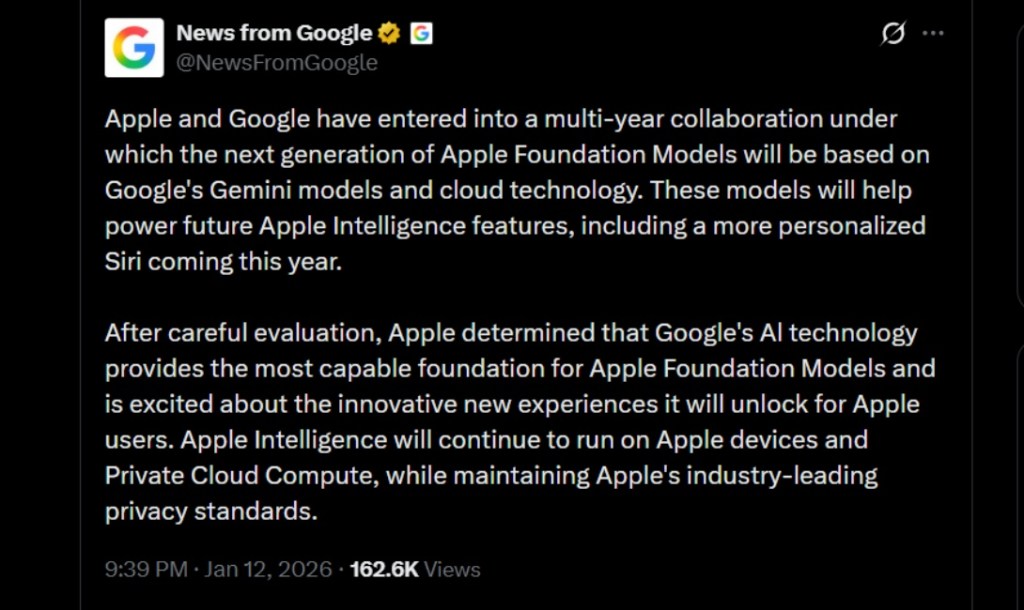
Image Credit: X/@NewsFromGoogle
Both statements clearly mention that the Cupertino Giant will be using Gemini to power its assistant Siri. This was already rumored, as Apple’s attempts to acquire Perplexity went nowhere. With Gemini, Siri will get a major AI update . It will be able to handle more nuanced conversations and provide better results. Something long-time Apple users have been asking for years.
The next-gen Siri will arrive with the iOS 26.4 update, which will launch sometime in March or April. And it is only going to be available for Apple Intelligence-supported devices .
Something else worth noting is how Google’s statement mentions that Gemini will power Apple Intelligence features. This leads us to believe that Apple could use Gemini’s multi-modal capabilities for its Writings tools , Image Playground , and Message summaries, too.
Elon Musk Not Happy With Apple and Google Tie Up
xAI CEO Elon Musk also responded to Google’s announcement post on X, sharing his thoughts on the matter by saying, “This seems like an unreasonable concentration of power for Google, given that they also have Android and Chrome.” Though we don’t expect either Apple or Google to respond to Elon, we will update the situation as it progresses.
It is worth noting that xAI is the company behind Grok, which is in hot water currently due to its inappropriate image generation fiasco , and has been getting backlash from multiple news outlets, X users, and even government authorities.
With over 4 year of experience under the belt, I cover all facets of consumer tech, from smartphones to other consumer electronics, our favorite social media apps, as well as the growing realm of AI and LLMs. As an Apps and AI writer app Beebom, I provide my expertise in all these areas, weaving stories that help you get familiar with the tech around you. But you will find me playing NYT daily puzzles in my free time.
Add new comment
Name
Email ID
Δ
